- Description
- Specifications
1440p at 360Hz, With Per-Pixel Black Levels Behind It
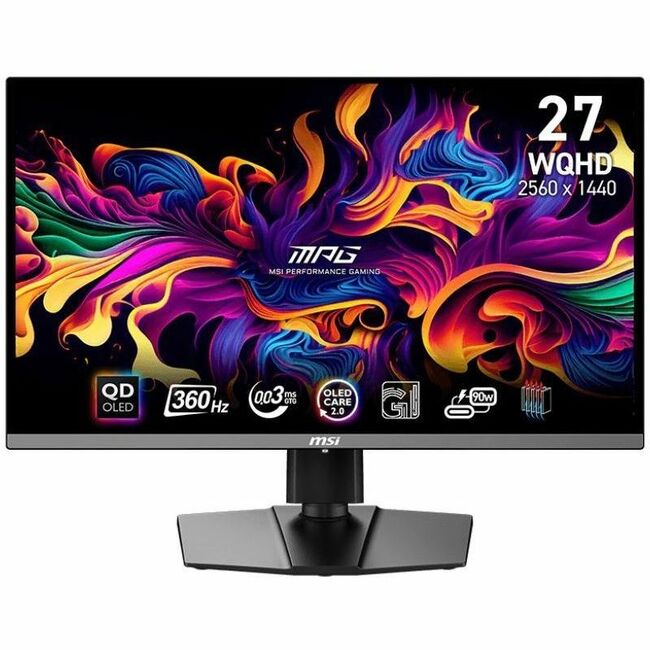
QD-OLED is a panel type that puts a quantum dot layer over a self-emissive OLED substrate, so each pixel makes its own light and switches off completely for black. On the MPG 271QRX that yields a 1,500,000:1 native contrast ratio and a 0.03 ms GTG response across 2560 x 1440 at up to 360Hz. MSI pairs the panel with an anti-reflective coating, a frameless bezel, and a fully adjustable stand covering tilt, swivel, pivot, and height. Compare it against the rest of the computer monitors range at Island Electrical Supply.
Where It Fits
- Competitive play, where the 360Hz ceiling and 0.03 ms GTG response are the numbers that matter most.
- Dual-system desks, since the built-in KVM switch and USB hub let one keyboard and mouse drive two machines.
- Color work alongside gaming, at 99% DCI-P3, 98% Adobe RGB, 138% sRGB, and 1.07 billion colors.
- Multi-input setups running two HDMI 2.1 sources plus DisplayPort 1.4 without swapping cables.
What It Delivers
- Quantum Dot OLED panel: 26.5 inches viewable at 16:9, 0.2292 mm pixel pitch, 178 degree viewing angles both axes.
- VESA DisplayHDR True Black 400 certification, the tier written specifically around OLED black performance.
- Adaptive Sync tearing prevention across a 45Hz to 360Hz vertical range.
- Gaming aids built into the OSD including a crosshair overlay and sRGB mode.
- VESA mount compatible at 18.3 lb, with a cable lock slot for shared or public desks.
Is a QD-OLED Monitor Worth It?
It depends on what a display is being asked to do. The measurable gap against a conventional LED-backlit panel is contrast and response: 1,500,000:1 native here versus roughly 1,000:1 on a typical IPS monitor, and 0.03 ms GTG versus figures an order of magnitude slower. That combination is what makes dark scenes hold detail instead of washing to grey and fast motion stay legible instead of smearing. The color coverage follows the same pattern, with 99% DCI-P3 and 98% Adobe RGB putting it in range for color-managed work rather than gaming alone. Where a conventional panel still leads is sustained full-screen brightness, and this model is rated at 250 nits, so a desk in direct sunlight is the one scenario worth planning around.